
Cleveland County Projected vs Actual Release
A projected release date is a prospective calculation. NCDAC uses the exact label Projected Release Date in a state offender detail. Sentence history can separately display Actual Release Date after an event occurs. The dedicated Inmate Releases index uses Release Date and Type of Release for completed state-prison events. A projected field should never be restated as confirmed or guaranteed.
For a person in a Cleveland County Sheriff facility before judgment, there may be no sentence-based date to compute. Bond, dismissal, a court order, a hold, or a transfer can determine when and where custody ends. A docket may supply the legal authority, but the Sheriff’s release event supplies the actual departure or transfer time. A name vanishing from the current P2C roster proves neither release nor its destination.
A sentenced county inmate and a sentenced state prisoner also follow different record paths. The Sheriff and Cleveland County court hold the local computation and judgment. The North Carolina Department of Adult Correction holds the state-prison sentence and credit calculation. Always identify the custodian before interpreting a date.
Find a Cleveland County Inmate Release Date
Begin with the last known custody and the person’s exact identifiers. The following sequence keeps county jail, state prison, and supervision records from being mixed.
- Check the Cleveland Sheriff P2C current inquiry. A match indicates current county detention; no match is only a clue.
- For a county matter, obtain the filed judgment or order through the North Carolina court Portal or Cleveland County Clerk. Identify bond, time served, probation, an active term, or state commitment.
- Ask the Sheriff or court custodian for the recorded local release calculation when a county jail sentence is involved.
- For state custody, search the NCDAC generic OPI by name, offender number, date of birth, or other available field.
- Open the correct detail and compare sentence blocks, projected release, actual release, incarceration status, and post-release supervision status.
- After a state release, check the NCDAC Inmate Releases search for Release Date and Type of Release.
- Confirm a future or newly posted date with the custodian before relying on it, especially when multiple sentences or holds appear.
The NCDAC release form can be narrowed to Cleveland County, year, month, last name, and optional soundex. On the research date, the form offered 2024 through 2026, which should be treated as a rolling interface rather than a permanent archive rule. Results show offender number, name, release date, primary offense, and release type. This is state-prison information associated with Cleveland County, not a list from either Sheriff jail building.
For the broader custody and records sequence, the Cleveland County released inmate lookup shows how P2C, court records, NCDAC, and written requests corroborate one another.
Note: A pretrial detainee has no reliable sentence-based release date until the court and all custodial holds permit release.
NCDAC Cleveland Release Date Fields
The generic OPI record needs to be read as a set of linked fields, not as one headline date. Its status filters include All, Active Inmate, Active Probationer/Parolee, and Inactive. “Inactive” is a database or supervision category. It is not a substitute for the actual release entry, and it does not rule out active post-release supervision.
| Field | What it establishes |
|---|---|
| Projected Release Date | The current prospective NCDAC calculation, which may change. |
| Actual Release Date | A completed state incarceration event shown in sentence history. |
| Type of Release | The official category attached to the indexed state release. |
| Incarceration Status | Whether the state incarceration record is active or inactive. |
| Probation/Parole/Post Release Status | Whether state community supervision remains active after confinement. |
| Minimum and Maximum Terms | The imposed sentence framework used with credits and release rules. |
| Sentence History | Admissions, convictions, term blocks, and dates that can explain the calculation. |
The fields may describe consecutive or consolidated sentences. One date should not be detached from the sentence block that produced it. If a projected date passed without an actual release, check for recalculation, a later term, revocation, a detainer, or a changed court order.
Cleveland Release Credit and Judicial Minimums
North Carolina does not have a safe universal rule that every offender serves about 85 percent. For structured-sentencing felonies, G.S. 15A-1340.13(d) requires service of the judicial minimum. Earned time can reduce the maximum, but not below that minimum. The minimum and maximum framework appears in G.S. 15A-1340.17.
The official felony rule is captured from the North Carolina General Assembly source below.
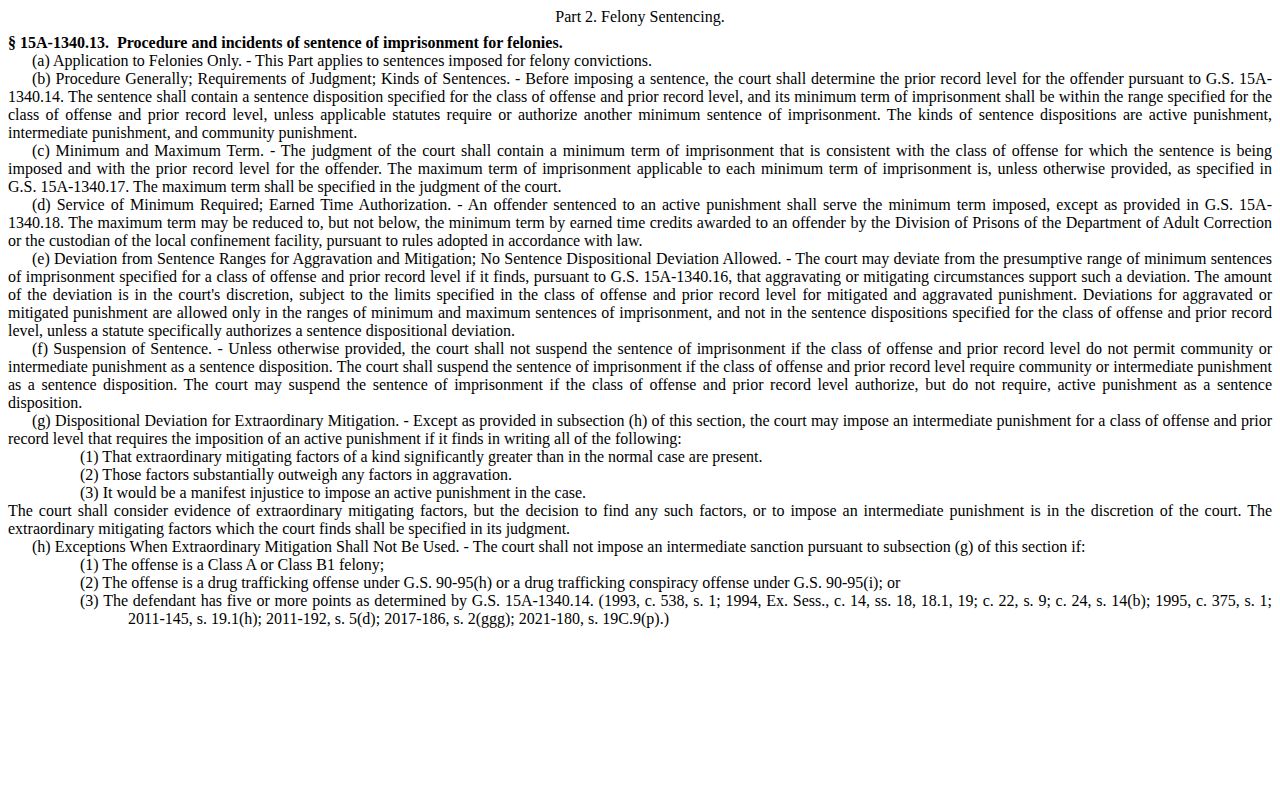
The statute explains why earned credit cannot simply cut a judicial minimum by a generic percentage.
Credit for qualifying prior confinement is governed by G.S. 15-196.1. It can explain why a custodian’s calculation differs from adding the full term to the judgment date. Earned credits under Article 81B are recognized by G.S. 15A-1355. These rules still do not provide enough data for an outsider to compute an individual release date from a charge and sentence length alone.
Note: Obtain the custodian’s recorded calculation because sentence blocks, qualifying confinement credit, and earned credit may not all appear in one public view.
North Carolina Release to Supervision Dates
Leaving prison may begin post-release supervision rather than end state authority. G.S. 15A-1368.2 generally places release to supervision at the maximum less 12 months for Class B1 through E felonies, maximum less nine months for Class F through I felonies, or maximum less 60 months for specified reportable sex-offense maximums, less earned time. Offense date and the controlling statutory regime matter.
Subsection (d) permits earned time to reduce the supervision period, capped at 20 percent of its original length. That detail shows why a prison release date and full state discharge date are different. OPI may show incarceration inactive while post-release supervision remains active. The first field reflects departure from prison; the second reflects continuing supervision.
The post-release supervision calculation source is shown below.
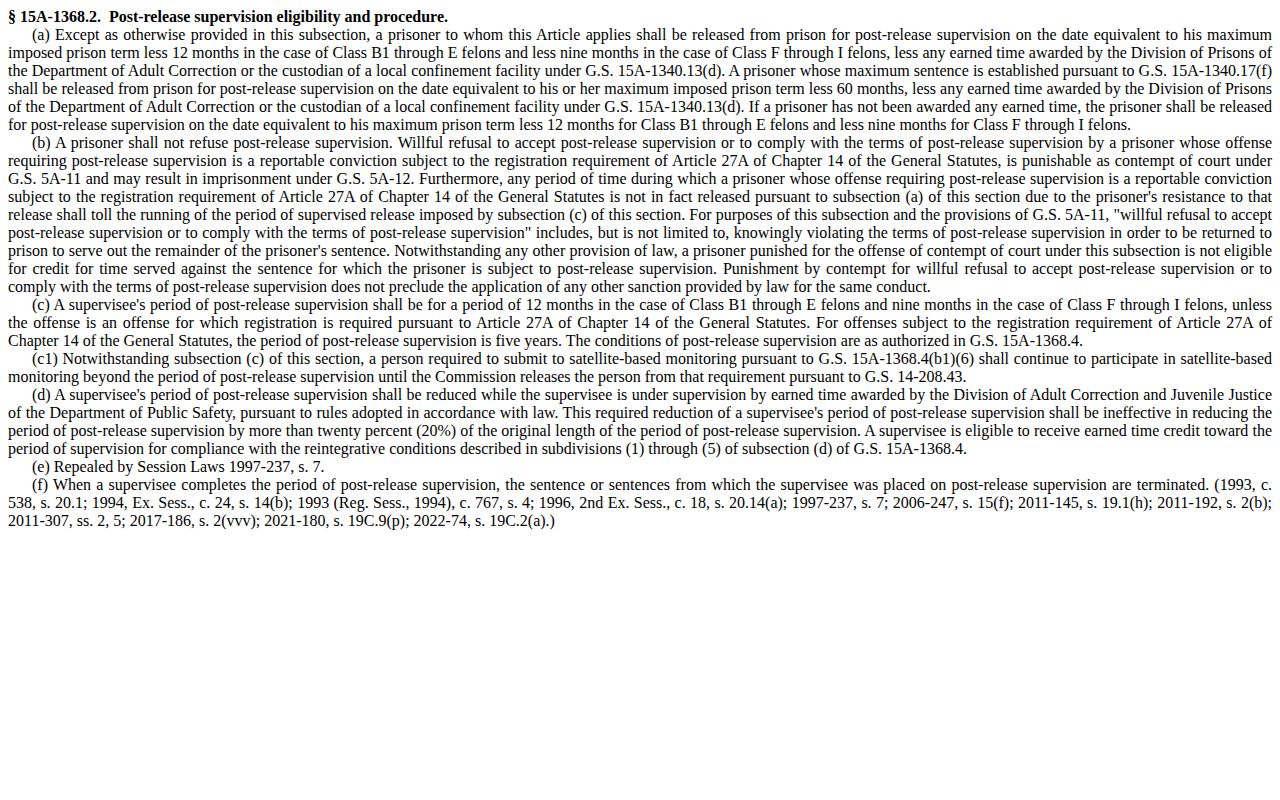
The statutory maximum-minus-supervision structure is the reason a single 85-percent shortcut fails in North Carolina.
Cleveland County Jail Release Computation
For a Cleveland County jail sentence, start with the written judgment, identify credit for prior confinement, and ask whether an applicable local earned credit was posted. G.S. 162-60 provides four days’ reduction for each 30 days of faithful assigned work and a similar education, rehabilitation, or training credit for qualifying misdemeanants, subject to its conditions. G.S. 15A-1340.20 caps combined misdemeanant earned time at four days per month.
Sheriff Alan Norman’s Cleveland County Detention Division page confirms the two local jail buildings. Check current custody through the official P2C inquiry, then obtain the controlling order through the Cleveland County court channel. Each source answers a different part of the date question.
These local confinement provisions do not apply to bond, dismissal, or a separate court-ordered release. They also do not authorize a public calculator to decide what credit a specific person earned. Ask the Sheriff or court custodian for the recorded computation and use the booking and case identifiers to keep the request focused.
No official Cleveland County weekend-adjustment rule or fixed release hour was found. A Sunday date should not be converted to Friday by assumption. Both Sheriff buildings operate around the clock, but continuous staffing is not a promise that release processing occurs at a set hour.
Cleveland Release Types Change the Date Meaning
The release type is as important as the date. A county pretrial bond release ends that booking’s physical detention after processing, subject to any other hold. Time served reflects sentence credit and a court outcome. A dismissal may remove the authority for custody in one case, but another case or agency hold can still control. A transfer records movement to a receiving custodian, not return to the community.
NCDAC uses release categories tied to state confinement procedures, including expiration, court-ordered release, parole, and post-release supervision. The dedicated release index pairs the event date with Type of Release so the date is not read without context. When OPI shows an actual release followed by active supervision, the person is out of the prison facility but has not reached full discharge.
A state-prison release also carries rules that should not be imported into Cleveland County jail practice. G.S. 148-13 provides at least $45 to a person paroled or discharged after at least two years of imprisonment. It is a state discharge provision, not proof of local jail gate money or a way to compute the release date. Keeping facility type and event type together prevents a state rule from being presented as a Sheriff policy.
When requesting a durable county record, supply the name, booking or case identifier, and a bounded date range. Ask for the admission date, actual release date and time, release disposition or destination, and receiving agency if transferred. The agency need not create a calculation or list it does not keep, so request the existing record and the recorded computation rather than asking staff to predict a date.
Why Cleveland Release Dates Change
A projected date is recalculated as the official record changes. The factor must be tied to the right sentence and agency before it explains a date movement.
| Factor | Possible effect | Record to check |
|---|---|---|
| Earned credit awarded or lost | Moves the computation within statutory limits. | NCDAC or local custodian credit record. |
| Prior confinement credit | Changes time credited against the sentence. | Judgment and qualifying confinement calculation. |
| Consecutive or consolidated terms | Changes which sentence block controls the date. | OPI sentence history and filed judgments. |
| Court amendment or order | Can alter the term or authorize release. | Filed Cleveland County court order. |
| Detainer or receiving agency | May prevent community release despite the end of one custody term. | Custodian release or transfer event. |
| Supervision revocation | May return a person to custody and create a new calculation. | Commission, court, and NCDAC status records. |
A release to another agency is not release to the community. If Cleveland County records show a transfer to NCDAC, another county, federal custody, or immigration custody, continue in that receiving system. The projected date for one custodian does not resolve a separate hold.
Confirm a Cleveland County Release Date
Use the date as a lead until the responsible custodian confirms the event. For state prisoners, compare OPI’s projected field with the dedicated release index after the expected date. Read Type of Release and any active supervision status. For county custody, pair the Sheriff release event with the court disposition. If a projected date passes without an actual event, do not announce that the person was released.
NC SAVAN can send a projected-release notice and later a release notice. Those are distinct alerts. Registering through the Cleveland County VINELink release check can help track the change, but the alert remains a prompt to verify with the Sheriff or NCDAC. Preserve the offender number, booking number, case number, and capture date when requesting clarification.
Note: Projected release, actual release, transfer, and final discharge are separate events and may appear in separate agency records.