
Cleveland County Parole vs Probation
Parole and probation both place a person under rules in the community, but they arise in different ways. Probation is commonly part of a court judgment and may begin without a state-prison term. Parole is conditional release under an older sentencing framework. Post-release supervision is the modern supervision period that follows many North Carolina prison terms. The North Carolina Post-Release Supervision and Parole Commission sets post-release conditions, makes the remaining parole decisions, and may revoke supervision. NCDAC Community Supervision carries out day-to-day supervision.
| Status | How it begins | What to verify |
|---|---|---|
| Probation | A court orders community supervision, sometimes instead of active confinement. | Judgment, active probation status, supervising county, and term dates. |
| Parole | The Commission conditionally releases an eligible person under the applicable sentence law. | Parole dates, Commission action, current location, and active or inactive status. |
| Post-release supervision | A person leaves NCDAC prison and serves a required supervision period. | Actual prison release, active supervision, conditions, and final discharge. |
A person who merely bonds out of the Cleveland County Detention Center or Law Enforcement Detention Center is not shown in state correction records for that reason alone. The court file and Sheriff custody record establish that county event. State OPI becomes relevant when the judgment imposes probation, a person enters NCDAC custody, or Community Supervision has a record.
Verify Cleveland County Post-Release Supervision
The official starting point is the NCDAC Offender Public Information search. It covers state prison, probation, parole, and post-release supervision records rather than the live Cleveland County jail roster. Search carefully because a shared name is not enough to identify the right person.
- Enter a name, offender number, date of birth or range, or other available identifiers. Soundex can help with spelling variations.
- Use the Active Probationer/Parolee filter when current supervision is the issue, but repeat with All if the first search is blank.
- Open the matching detail only after comparing the offender number and identifying fields.
- Read incarceration status separately from probation, parole, and post-release status. One may be inactive while another remains active.
- Check the current location, supervision dates, sentence history, and parole dates that the record supplies.
- Use the official office shown in the record. If none appears, contact NCDAC through its verified statewide channel instead of relying on an old directory result.
- Compare the state entry with the filed Cleveland County judgment when the legal basis or term is unclear.
The generic OPI database includes current and historical prison, probation, and parole information dating back to 1972, subject to record limits. That depth differs from the dedicated NCDAC Inmate Releases search, which is geared to actual state-prison release events. Neither is a Cleveland County jail release archive.
For an example of the official interface, the North Carolina parole process is shown in this captured source view.
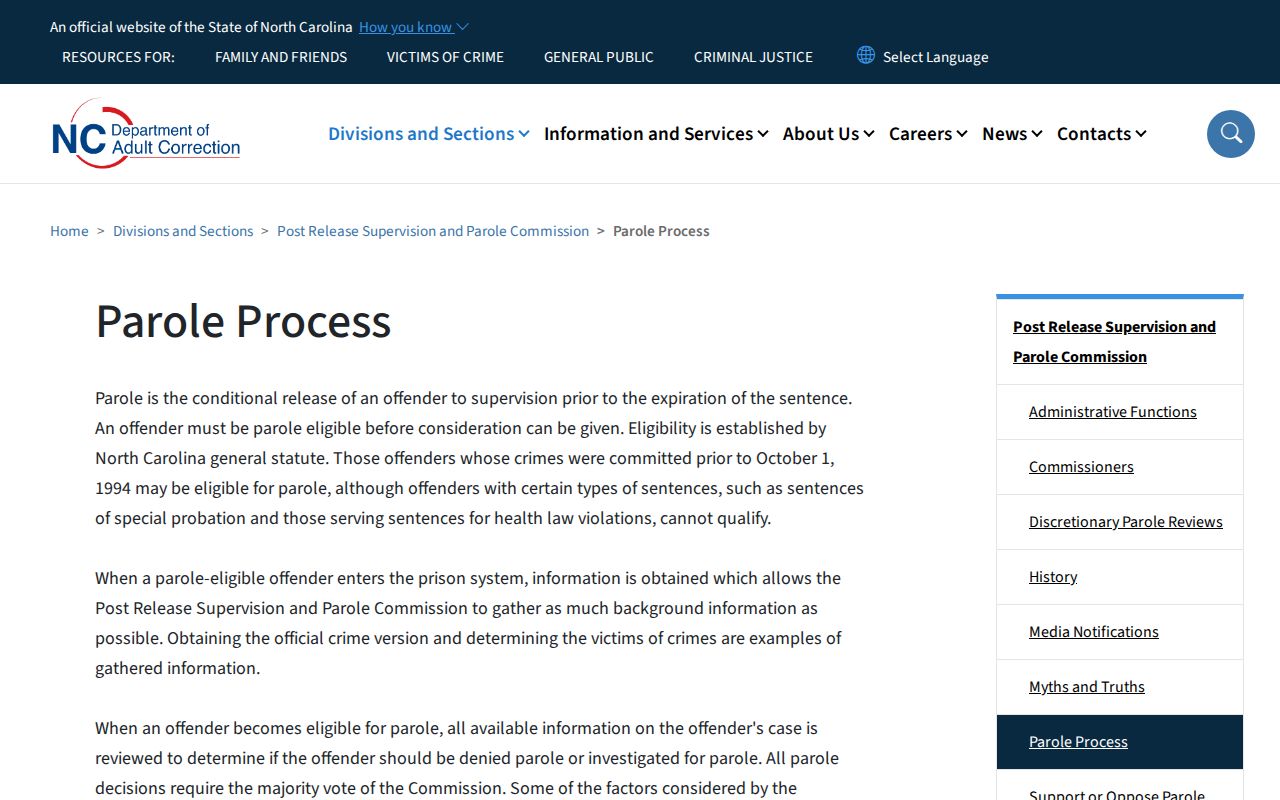
The source helps distinguish Commission decisions from the Community Supervision record used to check a person’s current status.
Note: A blank OPI result may reflect spelling, timing, jurisdiction, or restricted data and does not prove that supervision never existed.
Cleveland County Supervision Office Records
No current official local office-directory entry was found for a Cleveland County supervision office in the sources reviewed. Publishing an unverified Shelby address or number could send a reader to a stale location. OPI is the safer routing tool because its person-level record can identify the current location and supervision context. If it lists an office, use that entry. If it does not, use NCDAC’s current statewide contact route.
North Carolina Department of Adult Correction
Community Supervision handles probationers, parolees, and people on post-release supervision.
Post-Release Supervision and Parole Commission
The Commission sets conditions, performs eligible parole reviews, and makes revocation decisions.
The Cleveland County Sheriff’s Office should be contacted when the question is whether a person is currently held in either county detention building. The Sheriff cannot be assumed to be the probation or parole office merely because the person was once booked locally. For the overall custody trail, the Cleveland County released inmate search path explains how the Sheriff, court, and NCDAC records fit together.
Sheriff Alan Norman’s Detention Division page identifies both local jail buildings. The Cleveland P2C inquiry is the present-custody check, while the Cleveland County courts page routes readers to the filed judgment. These local sources establish custody and court action, not the state supervision office.
Cleveland Release Can Mean Active Supervision
OPI can display Incarceration Status: INACTIVE while Probation/Parole/Post Release Status: ACTIVE and identify Cleveland County as the current location. This is not a contradiction. It means the person is out of the prison facility while state supervision continues. The actual release date documents the end of that confinement episode; the supervision field documents the obligation that remains.
Read sentence blocks and status dates before drawing a conclusion. A person may have more than one conviction or term. One sentence may be complete while another supervision period remains open. Likewise, a release-with-supervision notification is evidence that prison confinement ended, not that every condition ended. Final discharge should appear as its own event or status and should be confirmed with the agency when the public entry is unclear.
Cleveland County Absconded Probationer Search
NCDAC provides a separate Absconded Probationer Search. It can filter County of Supervision to Cleveland. A matching result means the public system classifies that person as absconded from supervision. It does not say the person was successfully discharged, and it does not establish that the person is currently in the Cleveland County jail.
Use an absconder match as a focused official lead. Compare the identifiers to generic OPI, then seek law-enforcement confirmation for any current warrant or custody question. An absconder has allegedly failed to remain in contact or comply with supervision. That status does not erase the earlier prison release. It signals an unresolved supervision matter that may lead to arrest, a violation proceeding, or return to custody.
The official NCDAC absconder interface is preserved in the image below.
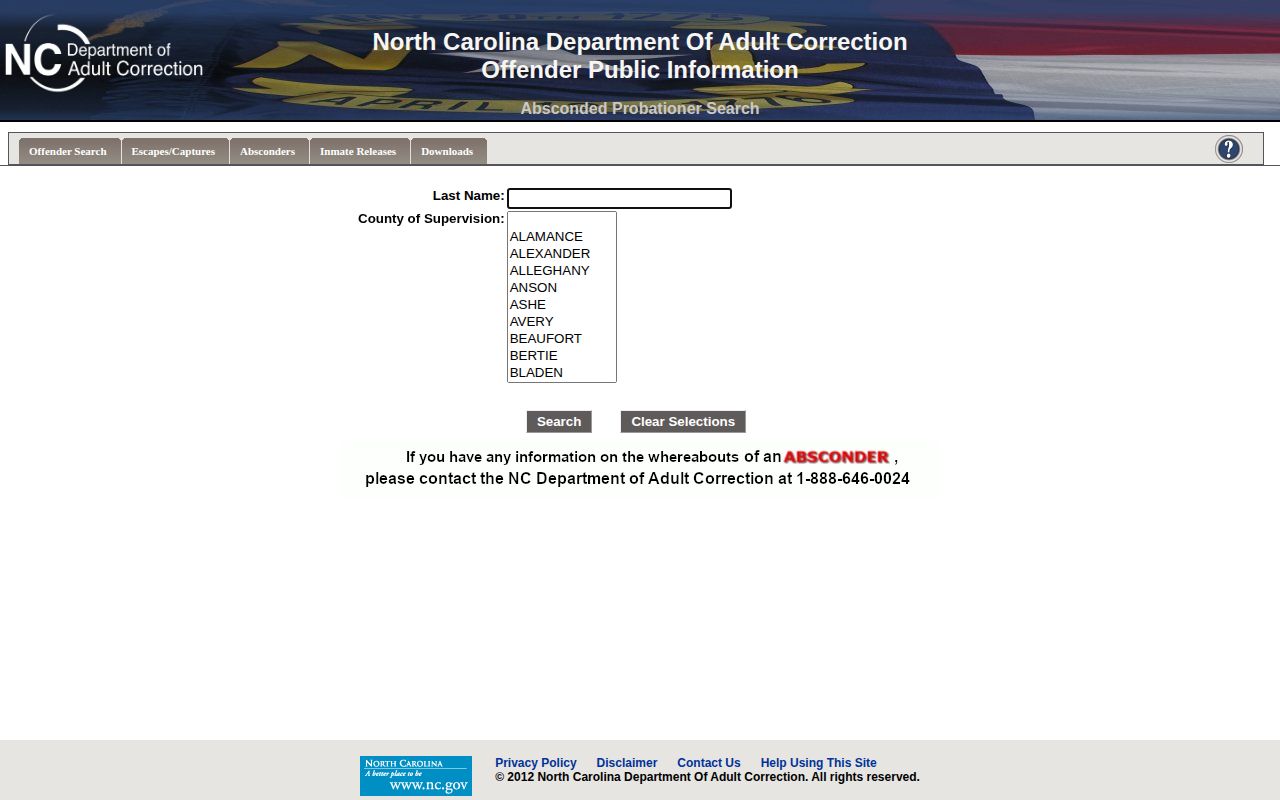
Its county filter is useful because it narrows the supervision location, not the place of the original jail booking or conviction.
Note: Do not infer a present arrest, jail location, or discharge solely from an absconder search result or its absence.
North Carolina Parole Review Has No Calendar
North Carolina differs from states that stage routine public parole hearings. The Commission explains that ordinary parole review involves no formal hearing and no personal meeting with the offender. Commissioners independently review the file, and a majority must agree. Therefore, there is no normal prospective public hearing calendar to use for a Cleveland County case.
Parole generally concerns crimes committed before October 1, 1994 because Structured Sentencing eliminated parole for covered later offenses. Eligibility still depends on the offense date, sentence law, and offense type. G.S. 15A-1371 contains several eligibility rules, so one sentence fraction is not a reliable answer. A narrow process exists for eligible juvenile lifers with the possibility of parole, but it should not be generalized.
The official substitute for a calendar is the Commission’s monthly Discretionary Parole Reviews. These retrospective reports begin in September 2024 and were listed through June 2026 on the research date. Terms such as Incomplete Decision, Suspend Decision, Regular Parole, Community Service Parole, Early Medical Release, and 90-day Mandatory Parole must be read as the Commission uses them. An incomplete decision is not the same as a grant or denial.
Cleveland County Supervision Changes and Alerts
Conditions vary by judgment and Commission action, so a public overview cannot state a person’s exact rules. At a high level, failure to comply may prompt investigation, a violation response, or revocation. The filed order, Commission record, and supervising agency are the sources for the actual terms. Chapter 132 supplies North Carolina’s public-record baseline, but it does not make every correctional or investigative record public.
NC SAVAN, also called VINELink, can carry county jail, state prison, probation, parole, and registered-offender events. A registered alert may flag release with supervision, release without supervision, escape, capture, or another custody change. It is useful notice, yet it is not the judgment or supervision-discharge record. Verify the alert with OPI, the Commission, or the custodian that created the event.
How Cleveland County Supervision Ends
Supervision ends through an official discharge or expiration under the controlling judgment and agency record, not simply because a name disappears from a search result. Start with OPI and examine the status and term fields. If the entry remains active after an expected end date, contact NCDAC with the offender number and the relevant case details. If a court order changed the term, obtain that filed order as well.
Completion has consequences beyond the status screen. North Carolina expunction eligibility can depend on completion of the whole sentence, including final expiration of probation, parole, or post-release supervision. That is another reason to preserve the discharge record and not substitute a prison release date. The date a person left confinement and the date state supervision ended can be months or years apart.
If a status appears inconsistent, preserve the OPI capture date and offender number, then obtain the filed judgment and contact NCDAC. A current screen can change after a court amendment, revocation, or agency update. Durable records make it possible to distinguish a delayed public display from a real extension or new supervision event.
Note: Keep the offender number, judgment, actual release entry, and supervision-discharge record together because each proves a different part of the timeline.