
Law Enforcement Detention Center Releases
The Law Enforcement Detention Center is the second building in the Cleveland County Sheriff's Detention Division. A person can leave 100 Justice Place without leaving county custody, because the Sheriff also operates the Cleveland County Detention Center on McBrayer Street. Ask whether the person left the whole division. An internal building move is not a release, and a handoff to NCDAC, another county, or a federal or immigration authority is still custody.
A community departure follows a legal basis such as bond, dismissal, time served, or completion of a county sentence, plus the Sheriff's processing. The court record explains the legal action. The jail record establishes the actual physical event. These records may have different times because an order can precede identity checks, hold resolution, property processing, or transport.
| Question | Best Cleveland source | What it proves |
|---|---|---|
| Is the person shown in county jail now? | Sheriff P2C | Current roster presence, subject to update limits |
| What did the judge order? | Cleveland County clerk or Portal | Disposition, judgment, bond, or release authority |
| When did physical custody change? | Sheriff custody event | Departure, transfer, and destination kept in the booking record |
| Did state custody follow? | NCDAC OPI | State incarceration or supervision status |
Use the complete Cleveland County release-record search path when the booking, court, and next-custodian records must be reconciled.
Verify Law Enforcement Detention Releases
The official Cleveland Sheriff P2C inquiry is a current-custody grid. It does not offer an official 24-hour or 72-hour release archive. A name that no longer appears may indicate release, transfer, an internal change, a spelling difference, or delay. Confirmation requires a person match and a direct custody event.
- Search the full name. Try the known first, middle, and last name and compare age, charge, booking agency, and arrest date.
- Ask about both buildings. Call the Detention Division and make clear that the question concerns all Cleveland County Sheriff custody, not only 100 Justice Place.
- Identify the event. Request whether the record says community release, bond, sentence completion, internal movement, or transfer to a named authority.
- Compare the case. Match the booking to the Cleveland court number and obtain the order, judgment, or disposition that supports the change.
- Follow continuing custody. Search NCDAC only if the Sheriff record indicates state commitment. Contact the named custodian for any other transfer.
Ask whether the person left the entire Cleveland Detention Division. Leaving one of its two addresses does not establish community release.
NC SAVAN, also known through VINELink, may supply a cross-system custody alert. It remains a notification layer, not the originating release certificate. A time-sensitive or legally important question belongs with the Sheriff, court clerk, or the receiving custodian shown in the record.
Law Enforcement Release Records Contact
The Sheriff detention page identifies the Law Enforcement Detention Center and says both division buildings are staffed 24 hours a day, seven days a week. The detention directory number is the best first call for an immediate routing question. Public administrative or records service may still follow different hours.
Law Enforcement Detention Center
100 Justice Place
Shelby, NC 28150
Sheriff main/nonemergency: 704-484-4888
Detention directory: 704-484-4889
For an existing record, email public.information@clevelandcountync.gov or mail Public Records' Request, Cleveland County, P.O. Box 1210, Shelby, NC 28151-0120. Identify the person, booking date, booking number, charge, and case number. Ask for admission and release date and time, release type or disposition, destination, transfer agency, and any releasable booking photograph.
The county records page states that written requests are acknowledged and processed in order. It publishes neither a flat release-record fee nor a fixed completion time. Any cost is communicated. A public body must provide existing records subject to law; it need not write a new report that it does not keep.
About Law Enforcement Detention
This facility is a county-jail building, not a state prison. The Cleveland County Sheriff's Office operates it within the same Detention Division as the McBrayer Street center. The shared custody context matters more than the street address when searching for someone. The live inquiry may reflect the county system without giving a public building-by-building release archive.
P2C currently exposes identity and demographic items along with primary charge, arrest date, and booking agency. A response may also carry a booking identifier and date of birth. As reviewed on July 30, 2026, the public grid did not show a release-date column, release type, released filter, recent-release window, or list-photo column. The Sheriff did not publish its exact refresh interval or roster retention period.
- Community release
- The Sheriff ends physical detention and the person is not handed directly to another custodian.
- Internal movement
- A change between Sheriff detention buildings with county custody continuing.
- Commitment
- A court-directed move into another correctional authority, commonly NCDAC for a state sentence.
- Discharge
- The formal end of a custody or supervision term, distinct from release onto ongoing supervision.
Law Enforcement Release Court Check
The Cleveland County Courthouse shares the 100 Justice Place address. This makes a two-record check practical, but proximity must not blur the records. The clerk maintains the case file, disposition, judgment, and release order. The Sheriff maintains the jail custody event. A courthouse appearance is not itself a physical release, and an order may require further jail processing or resolution of another hold.
The Cleveland County Courthouse can be reached at 704-476-7800 and lists Monday through Friday hours of 8:30 a.m. to 5 p.m. Searches may begin through the statewide Portal, a clerk public terminal, or the paper file in the county of filing. Cleveland criminal case numbers use the CR designation, while infraction-only matters use IF. Use the exact number when linking the court outcome to a jail booking.
A release order proves legal authority, not the time the person walked out or entered another custodian's vehicle. Ask the Sheriff for the actual custody timestamp. If a detainer or another case delayed departure, the court and jail records together should show why the two moments differ.
Note: The courthouse and jail share an address but maintain different records, so verify both the legal order and physical custody event.
Follow Cleveland Custody Transfers
A transfer notation should name or at least identify the next authority. For an NCDAC commitment, use the official Offender Public Information search. It accepts name, soundex, offender number, sex, race, ethnicity, and birth or age fields, with status choices for active inmate, active probationer or parolee, inactive, or all. State details can include location, sentence history, actual release date, projected release date, and supervision status. They do not recreate the Cleveland County booking record.
The state discharge-cash authority shown below illustrates why a state-prison discharge must remain separate from a Cleveland County jail departure.
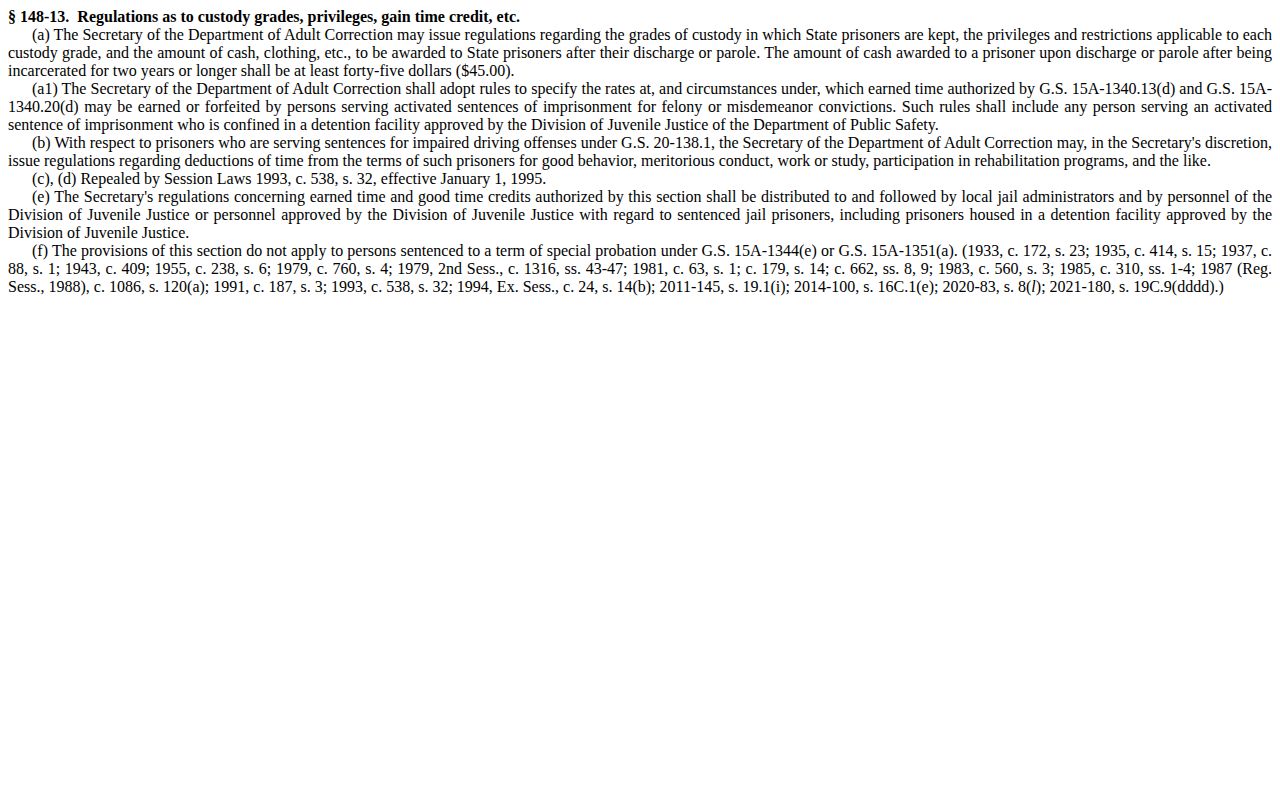
The statute can govern qualifying state-prison releases, not routine releases from the Law Enforcement Detention Center. A county record should never promise the state benefit.
Federal Bureau of Prisons and ICE tools have narrower jurisdiction. A BOP result showing released or not in BOP custody only ends BOP custody. ICE's locator can cover current detainees and some people released from ICE custody within the prior 60 days, subject to exclusions and lag. Neither result, standing alone, proves community release from Cleveland County. The Sheriff's transfer field remains the bridge to the correct system.
If a destination is unclear, ask for the transfer agency and date in writing. Avoid guessing from an absent roster name. The difference affects where records are held, who can confirm current custody, and whether a state or federal release date is relevant.
Avoid the Closed Cleveland Prison
Search engines may surface Cleveland Correctional Center because its name resembles the county and facility terms. NCDAC lists that state prison as closed in December 2009. It is not one of the Sheriff's active buildings and should not receive a current release request. The two active detention addresses are 100 Justice Place and 407 McBrayer Street.
The official closed-prisons list resolves the historical name. For current local custody, remain with the Cleveland Sheriff. For a documented state transfer, use NCDAC's current system. This distinction is especially important when older search results mix historical state records with a present county booking.
Keep a copy of the Sheriff response and the matching court order. Together they create a clearer timeline than a search-engine result or an unexplained disappearance from the current roster.
Record the date each online check was made. Public interfaces can change, and a later search may not reproduce the same current-custody view. A dated note, booking identifier, and agency response give the inquiry a traceable basis without treating the roster as a permanent archive.